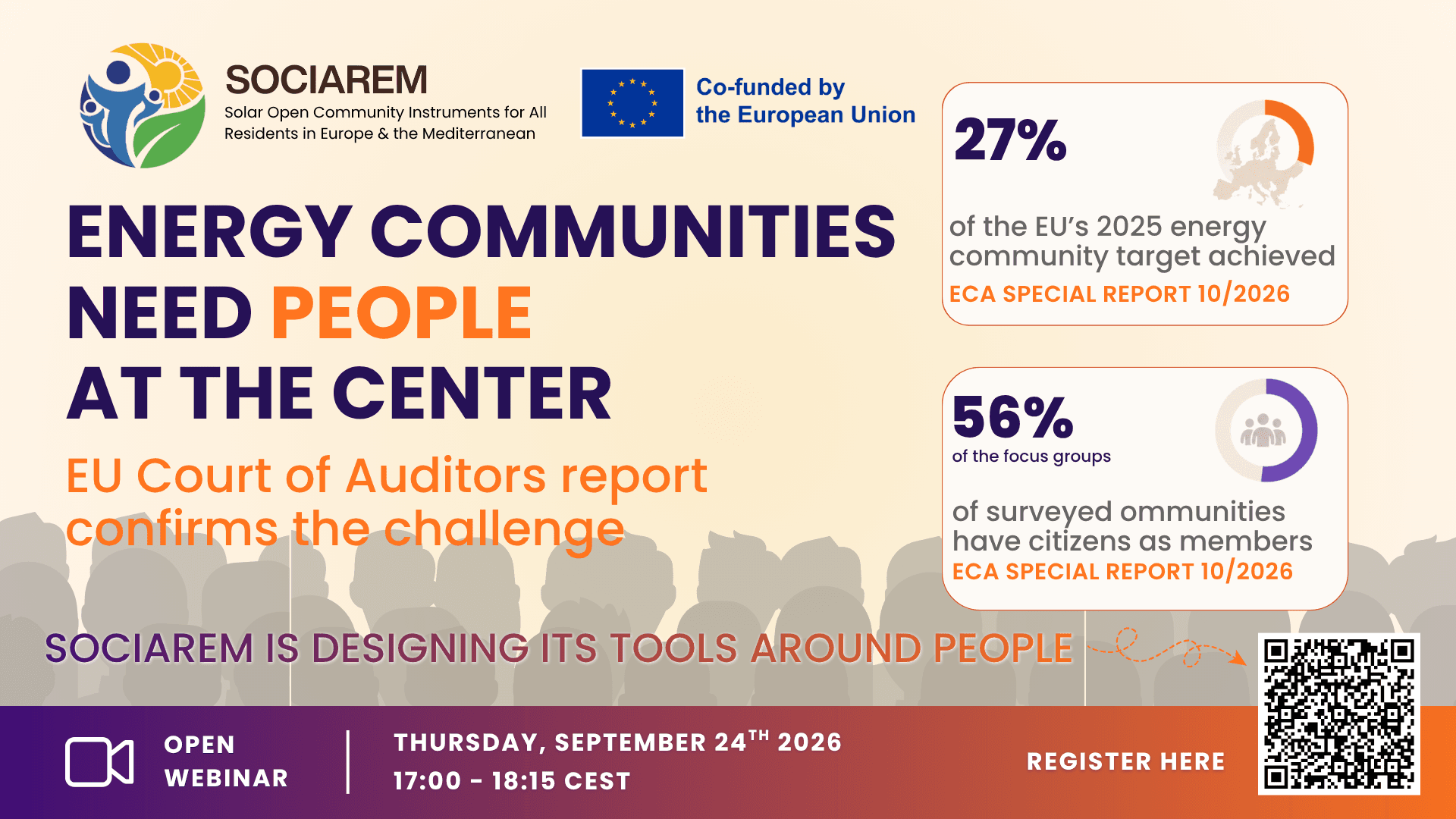
-A new Special Report from the European Court of Auditors finds the EU has reached only 27% of its 2025 target for renewable energy communities.
-The Horizon Europe project SOCIAREM will present its own findings and approach at a free webinar on Thursday 24 September.
The European Court of Auditors (ECA) has published Special Report 10/2026, "Energy communities – Potential yet to be fulfilled", adopted in February 2026. The audit assessed whether the European Commission and four member states, the Netherlands, Poland, Italy, and Romania, have successfully engaged energy communities to deliver on their expected benefits, and whether the EU is on track to meet the target set out in its 2022 Solar Energy Strategy: at least one renewables-based energy community in every municipality with more than 10,000 inhabitants by 2025.
As of January 2025, the EU had reached only 27% of that objective. The Court attributes this shortfall to several structural weaknesses: unclear and inconsistently applied definitions of energy communities across member states, a target that was never properly justified or assessed for feasibility, incomplete monitoring, and critically persistent failure across most audited countries to actively promote citizen participation or support for vulnerable households.
Findings that resonate with SOCIAREM's mission
Several of the report's observations speak directly to the challenges SOCIAREM (Solar Open Community Instruments for All Residents in Europe & the Mediterranean), was designed to address:
The Court found that none of the four audited member states had adopted specific legal provisions to actively promote citizen participation in energy communities, and only one had dedicated legislation supporting vulnerable households, despite this being one of the EU's stated goals for the model.
The report also highlights a concrete barrier affecting 48% of the EU population living in apartment buildings: current EU rules do not allow existing owners' associations to be used to set up an energy community, forcing residents to create an entirely separate legal structure — a significant, often underappreciated obstacle to inclusive participation.
Progress varies sharply by country. Italy, home to one of SOCIAREM's four demonstration sites, in Sicily, had reached only 2.1% of the EU target by January 2025, though the Court also noted a rapid 75% growth in the number of Italian energy communities between January and June of that year, suggesting real momentum once the right conditions are in place. These findings reinforce a central premise of SOCIAREM's work across its four demonstration sites: in Dübendorf (Switzerland), Nicosia (Cyprus), Vila Nova de Famalicão (Portugal), and Sicily (Italy). The barriers to energy communities are as much social and structural as they are technical, and closing them requires designing instruments explicitly around the people expected to use them, including residents who are currently excluded by default.
Sharing evidence at SOCIAREM’s open webinar
To contribute to this conversation, SOCIAREM is hosting a free webinar, "Designing Renewable Energy Communities Around People," on Thursday, 24 September (17:00–18:15 CEST, online). The session will include a European policy perspective, the key findings from SOCIAREM's own user research (Deliverable 1.2), and an overview of European funding opportunities available to support energy community development.
Free registration: https://www.eventbrite.es/e/designing-renewable-energy-communities-around-people-tickets-1993544257539?aff=erelexpmlt
AI-assisted content. Editorially reviewed and approved.