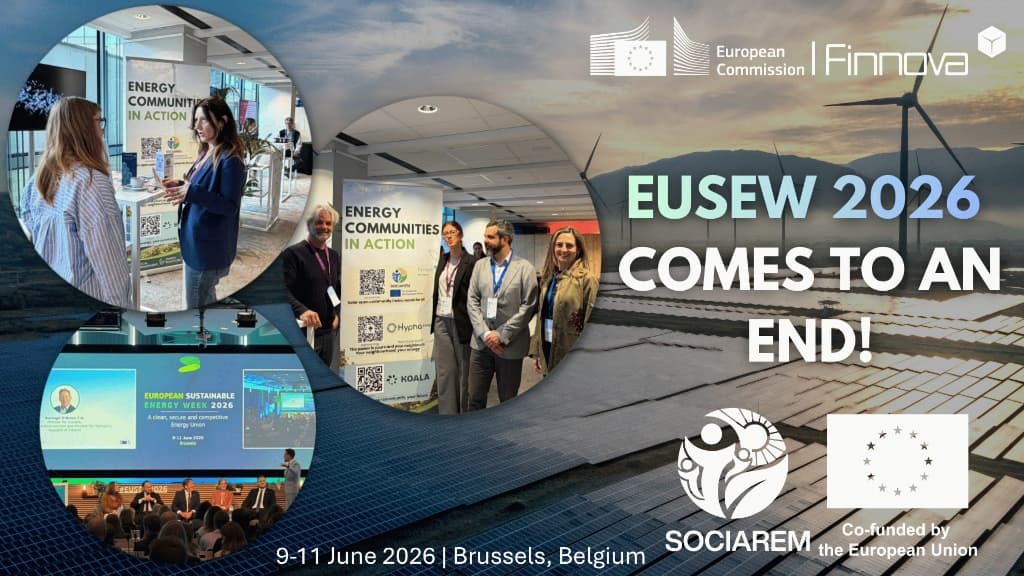
The Horizon Europe project concludes its presence at the EU Sustainable Energy Week 2026 with new strategic connections to advance Renewable Energy Communities.
SOCIAREM showcased its digital and social tools for citizen-driven energy transition at Stand 15, Charlemagne Building, Brussels.
Brussels, 12 June 2026. Following the close of the European Sustainable Energy Week (EUSEW) 2026, SOCIAREM wraps up a successful participation in the Energy Fair, marked by new partnerships, high-level exchanges and strengthened collaboration opportunities to accelerate citizen engagement in the clean energy transition.
Throughout the event, SOCIAREM presented its suite of solutions for energy planning, peer-to-peer energy exchange, smart grid integration, real-time optimisation, storage and e-mobility integration, and citizen participation. The stand, hosted by Adriana García, EU Communication Assistant, and Camila Delmar, EU Project Assistant at Finnova Foundation, attracted policymakers, researchers, energy companies, municipalities and EU-funded initiatives from across Europe.
Key exchanges to reinforce the social dimension of the energy transition
During EUSEW, SOCIAREM engaged with a wide range of stakeholders, including representatives interested in digital tools supporting Renewable Energy Communities, Horizon Europe and LIFE projects working on complementary technologies, and Mediterranean energy actors aligned with the project’s Euro-Mediterranean scope.
These exchanges reinforced the importance of integrating social considerations into the energy transition and highlighted the growing interest in approaches that combine technological innovation with citizen participation. They also enabled the identification of potential synergies with other EU-funded initiatives and stakeholders working on energy communities, social inclusion, and sustainable development, contributing to the broader objective of ensuring a fair and just transition for all.
Advancing towards a more inclusive and participatory energy future
EUSEW 2026 provided SOCIAREM with a platform to validate its citizen-centred approach, present its technological progress, and expand its network of potential partners. With demonstration sites in Switzerland, Portugal, Italy and Cyprus, the project continues to develop solutions that make Renewable Energy Communities more accessible, efficient and socially inclusive.
About SOCIAREM
Running from October 2025 to March 2029, SOCIAREM is a 42-month Horizon Europe project with a total budget of €5,572,687.50, co-funded by the European Union, together with the Swiss Secretariat for Education, Research and Innovation (SERI).
The consortium is coordinated byComillas Pontifical University (Spain), leading the project’s energy and social research, PV optimisation tools, and serious game development. The partnership gathers 15 organisations with complementary expertise: SMEs such as AKUYARI (Spain) and8D-Games (Netherlands) contribute innovation in user engagement and gamification; research centres including R&D Nester (Centro de Investigaçao em Energia Ren), Watt-IS andCEVE (Cooperativa Eléctrica do Cale d’Este, Portugal) bring strong technical know-how in renewable energy and P2P exchange; while Phoebe Research & Innovation Ltd (Cyprus) and EMPA (Switzerland) advance monitoring, optimisation, and planning tools for PV adoption. Academic partners such as the University of Cyprus, the University of Deusto (Spain), and the University of Aswan (Egypt) contribute leading research in smart energy systems, social sciences, and network planning. Civil society and community actors like FMES (Fondazione dele Comunità del Mediterraneo Sostenibili e Solidali per l’Inclusione e l’Accoglienza – Ente Filantropico) and Sinloc (Italy) ensure close collaboration with local energy communities, while Finnova Foundation (Belgium) drives communication and dissemination, and Zabala Innovation Consulting (Spain) manages exploitation and innovation. Together, this diverse consortium combines research excellence, technological innovation, and strong outreach capacity to maximise the project’s impact.