Madrid, 17 November 2026. Renewable Energy Communities (RECs) are becoming increasingly important in Europe’s energy transition, enabling citizens to participate directly in renewable energy production, consumption and management. However, their success depends on more than installing solar panels or integrating advanced energy technologies.
How are decisions made within an energy community? Who has access to relevant information? How should costs and benefits be distributed? And how can communities ensure that all citizens, including vulnerable households, have opportunities to participate?These questions are gaining attention at European level.
Last Tuesday, November 10th 2026, the European Union announced the recognition of ten energy communities from six countries, sharing €1 million in awards for innovative approaches to energy community governance. The initiative highlights the importance of organisational models that promote democratic participation, inclusive decision-making and fair access to the benefits of renewable energy. Among the recognised initiatives are the Spanish energy communities Manza Energía, CERCA and Manresa Il·lumina, illustrating the diversity of community-led approaches emerging across Europe.
Inclusive Governance: A Key Element of the Energy Transition
Renewable Energy Communities offer opportunities to move towards a more decentralised, sustainable and participatory energy system. By enabling citizens to collectively produce, consume, store and manage renewable energy, these communities can contribute to local energy resilience, increased renewable energy self-consumption and greater citizen involvement.
Nevertheless, establishing a successful energy community involves several challenges beyond technological implementation. Clear governance structures, transparent decision-making processes and equitable economic arrangements are essential to building trust among participants and supporting the long-term sustainability of community initiatives.
Inclusive governance also requires considering the different circumstances, expectations and capacities of community members. For example, households may have different consumption patterns, financial resources, levels of digital literacy or opportunities to invest in renewable energy infrastructure. Addressing these differences is particularly important to ensure that Renewable Energy Communities do not unintentionally exclude citizens who could benefit from participating.
The European recognition of innovative governance models therefore reinforces an important message: the energy transition is not only a technological challenge, but also a social and organisational one.
SOCIAREM: Combining Smart Grids with Citizen-Centred Energy Solutions
These challenges are closely aligned with the objectives of SOCIAREM, a project funded by the European Union’s Horizon Europe programme. The project combines smart grids, solar photovoltaic technologies, smart energy management and peer-to-peer (P2P) energy trading with approaches designed to strengthen citizen engagement and social inclusion.
Through digital tools, gamification and community-oriented solutions, SOCIAREM aims to facilitate participation in renewable energy systems, address barriers to engagement and contribute to a fairer distribution of renewable energy benefits. Its approach recognises that technological efficiency and social acceptance must develop together.
While smart grids and digital optimisation tools can improve energy management, the success of community energy models also depends on how citizens understand, access and participate in these systems.
From Research to Practice: Building Fairer Energy Communities
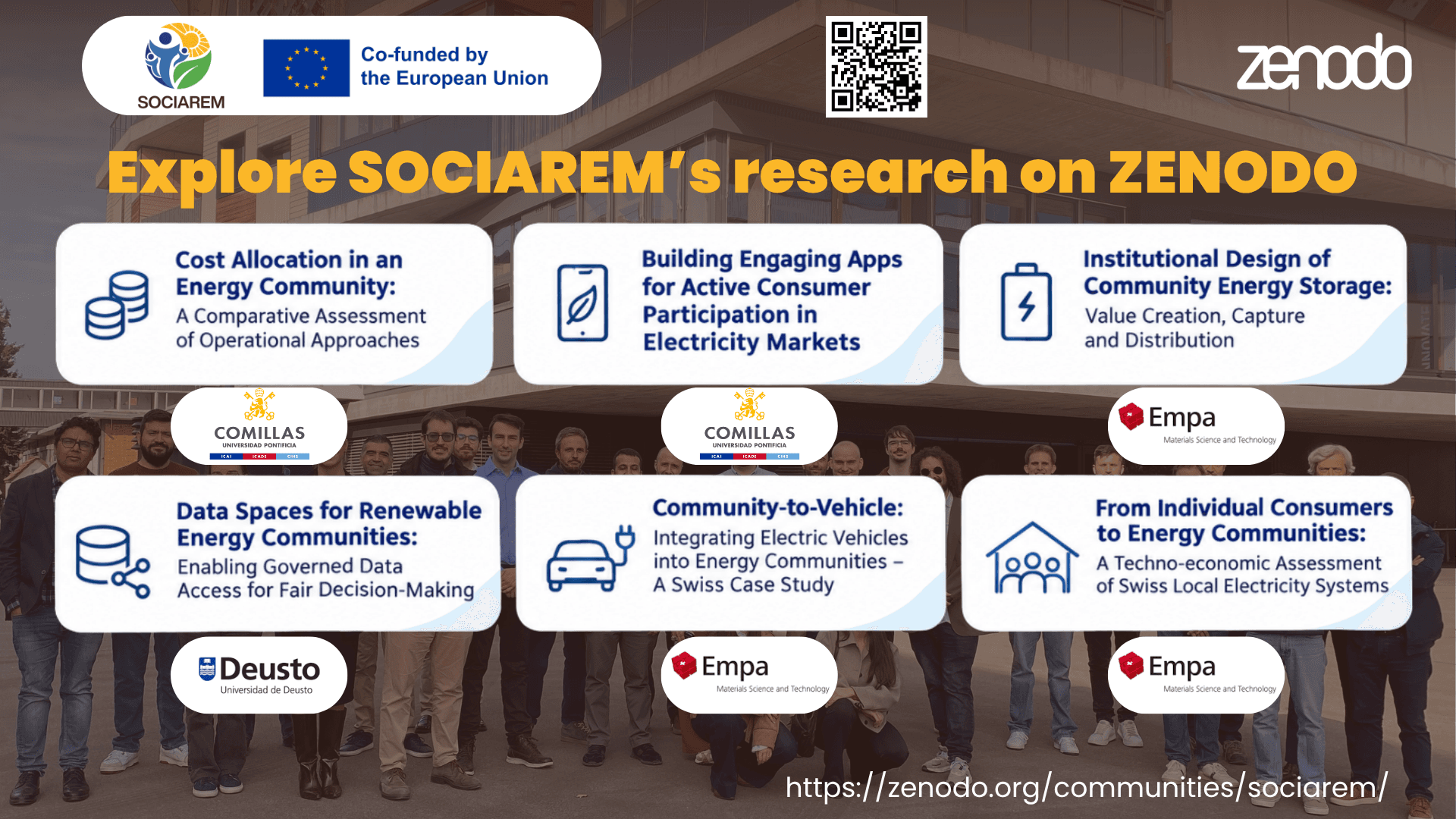
The importance of inclusive governance is also reflected in research publications available on Zenodo, exploring how data management, economic fairness and citizen participation can contribute to more sustainable Renewable Energy Communities.
The publication “Data Spaces for Renewable Energy Communities: Enabling Governed Data Access for Fair Decision-Making” addresses the role of data governance in supporting transparent decision-making, while “Cost Allocation in an Energy Community: A Comparative Assessment of Operational Approaches” examines different approaches to distributing operational costs. Similarly, “Institutional Design of Community Energy Storage: Value Creation, Capture, and Distribution” explores how the value generated by shared energy storage can be organised and distributed, and “Building Engaging Apps for Active Consumer Participation in Electricity Markets” focuses on digital tools that encourage consumer engagement.
These research areas closely align with SOCIAREM’s approach to combining smart grids, digital innovation and citizen-centred solutions. Through its four demonstration sites in Switzerland, Cyprus, Portugal and Italy, the project aims to explore how technological innovation, fair governance and active participation can contribute to more inclusive and efficient energy communities.